In this edition of AdSecure’s Violations Report, we analyze Malvertising data extracted from over 37M Malvertising prevention scans run on client campaigns. With this data you will discover how Malvertisers attacked websites and Ad Networks in Q1 2025. You will also learn how to prevent such attacks from affecting your ad supply chain, ultimately protecting your online business and your end user’s safety. Keep reading to find out the most dangerous Malvertising trends on Q1 2025!
Dangerous Malvertising trends on Q1 2025: Almost 1 in 4 scans detected 25 online safety violations
Nearly a quarter of all ads scanned by AdSecure contained at least one violation. This percentage includes User Security, User Experience, User Advisory, and IAB Standards violations. Any violations identified by AdSecure can significantly impact the online user experience and well-being. This includes compromising data security, damaging devices, disrupting navigation, exposing users to explicit content, or presenting low-quality ad creatives. Here’s the percentage breakdown of the most dangerous Malvertising trends on Q1 2025 compared to Q4 2024:
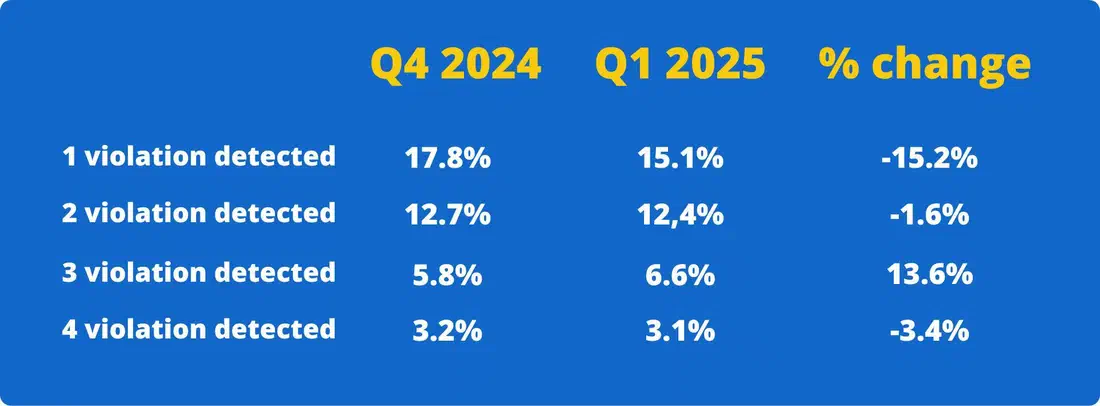
As we can see on the table above, overall violation numbers have decreased if we compare Q3 2024 to Q1 2025. However, 3 violations were detected in 6.60% of all scans. This is still a considerable amount to be taking into account when thinking of investing in online security and Malvertising prevention software.
Top 10 GEOs targeted by cybercriminals in Q1 2025
Let’s take a look at the top Top 10 GEOs targeted by cybercriminals in Q1 2025:
The United States (23.8%)
Germany (10.5%)
United Kingdom (10.4%)
France (8.7%)
Netherlands (8.6%)
Canada (8.5%)
Italy (7.7%)
Spain (7.5%)
Finland (7.2%)
New Zealand (7.1%)
As we can see, the US (23.8%), Germany (10.5%) and the UK (10.4%) are the 3 most targeted countries by online scammers and cybercriminals. Followed by France (8.7%), the Netherlands (8.6%) and Canada (8.5%). Once again, most of the top targeted countries are Tier 1, with malvertisers focusing on GEOs that can bring them higher revenues.
Insight: According to admonsters, (opens in a new tab) North America remains the hotspot for forced redirects, with 55% of malicious ads in the U.S. and Canada stemming from these attacks. While forced redirects are less frequent in Europe (30%), the US saw one in every 160 ads as malicious, showing slight improvement from 2023. Canada faces a much higher risk, with one in every 75 ads being malicious.
Top 7 ad violation increases from Q4 2024 to Q1 2025
Uncommon-protocols (User Experience) +249.10%: Normally computers use common communication protocols such as TCP/IP, DHCP, DNS, and HTTP. In some cases, communication may involve an uncommon protocol that can be used to activate undesirable actions like automatically opening an app or launching a Skype call - such actions impact the user experience.
Threat-intelligence +113.10% (User Advisory): This scan method detects the behavior of specific URLs. Then, the Threat Intelligence tool assigns a risk score from 5 to 0, indicating the likelihood and severity of potential ad violations. This enables proactive identification and mitigation of risks before they impact live systems.
Adware (User Security) +50%: Adware is software that downloads or displays unwanted ads when a user is online, collects marketing data and other information without the user’s knowledge, or redirects search requests to certain advertising websites.
Malicious-url (User Security) +38.6%: malicious URLs contain harmful content like phishing schemes and drive-by exploits, aimed at deceiving users into revealing sensitive information, downloading malware, and more. This violation can lead to significant financial losses and damage to devices.
Auto-vibrate (User Experience) +37.60%: These are ads that automatically vibrate on the end user’s device upon reaching the malicious landing page. This makes the end user feel unsafe and hinders the end user experience, making them flee the website where the malicious ad was found, and probably never come back.
Ssl-non-compliant (User Security) +11.79%: These ads include at least one unsecured element in the resource chain (such as unsafe content, lack of HTTPS, mixed content, or SSL version/cipher mismatches). This vulnerability could expose users’ information to unauthorized third parties.
Unsafe-content-adult (User Advisory) +6.73%: End users are exposed to unexpected and non-requested explicit sexual and inappropriate content. This can be very damaging to younger or vulnerable audiences, and can seriously hinder the website’s reputation.
Insight: AI use has become more and more obvious in the Malvertising world. With powerful AI and Deepfakes tools, (opens in a new tab) Malvertisers are now able to generate artificial explicit images for their malicious ads and landing pages. Equally, Romantic Scams, such as Fake AI girlfriend scams and Pig Butchering have been targeting unsuspecting vulnerable audiences at an accelerated rate.
IAB Standards violations in 2025
The IAB Standards, created by the Interactive Advertising Bureau, provide essential guidelines for Advertisers, website Publishers, and ad networks to maintain high ad quality, ensure compliance, and enhance the user experience. Adhering to these standards is vital for all parties in the ad tech and online business sectors, as failure to do so can negatively impact user experience and result in penalties or flags from Google. At AdSecure, we make sure these standards and technical requirements are fully upheld. Here’s the evolution of the IAB Standards violations in 2025:
IAB-ad-dimensions 86.50%: The IAB suggests specific ad dimensions that generate the most revenue and are compatible with various screen sizes. This detection will identify ads that don’t meet IAB standards for dimensions, giving you the opportunity to address size-related issues and improve loading times.
IAB-ad-compression 11.30%: What are standard IAB sizes? To optimize the file size for delivery of an ad to a browser, the assets within the ad should be delivered in compressed formats such as gzip. This detection will flag ads that are not compliant with the IAB standards within this category, which means they are not delivered in a compressed format.
IAB-ad-weight 1.80%: Ad weight is the total size of all the ad assets being delivered to the browser at a given phase. This detection will flag ads that are not compliant with the IAB standards in terms of ad weight (initial load and sub-load). IAB recommends an ad size with an initial load of maximum 50KB and a sub-load of maximum 100KB.
IAB-ad-request-count 0.40%: Ads consist of multiple resources. The number of requests made to fetch these resources has a significant impact on the load performance of the ad as well as on the page where the ad is displayed. This detection will flag ads that are not compliant with the IAB standards in terms of ad request count. IAB recommends a maximum of 10 requests.
Conclusion: Dangerous Malvertising trends on Q1 2025 and how to stop them
As highlighted above, in 2025, it’s essential to invest in both a strong compliance team and effective ad security software to protect your ad supply chain and users from harmful ads. With mobile malware campaigns targeting crypto platforms and Google cracking down on advertiser accounts, ensuring security is more important than ever. Contact our team to learn how to safeguard your advertiser accounts from fake Google attacks and begin securing your ad network or website today!