In 2024 we scanned over 168M Advertiser campaign scans to keep Ad Network ad supply chains and Publisher websites safe. In order to bring you useful information to help understand how Malvertisers endangered user security in 2024, to help you block Malvertising attempts and protect user experience and online safety, we bring you the Violations Report 2024, where we analyse cybercriminal activity and throughout the year coming directly from our platform stats.
How Malvertisers endangered user security in 2024: Almost 1 in 4 scans detected 20 online safety violations
Over a quarter of all ads scanned by AdSecure contained at least one violation, pointing out how Malvertisers endangered user security in 2024. This percentage includes User Security, User Experience and User Advisory detection categories, and ad creatives that do not meet the industry IAB Standards. All violations detected by AdSecure can seriously affect the experience and welfare of the online end user. Whether it is by putting their data’s security at risk, damaging their devices, hindering their navigation experience, exposing them to explicit content, or showing them poor quality ad creatives.
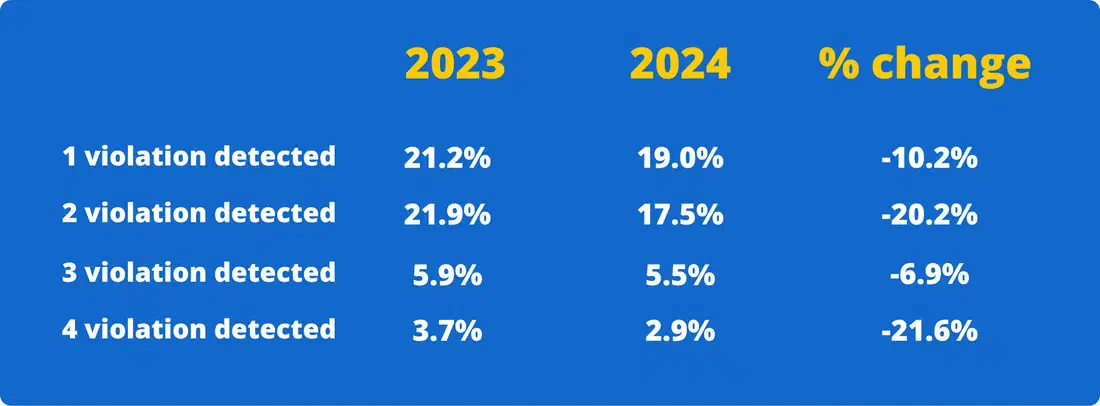
As we can see, overall violation numbers have decreased if we compare 2024 to 2023. However, it is paramount to still keep a watchful eye on your ad supply chains, since Malvertisers are constantly evolving and changing their methods to adapt to detection software advances.
Top 10 GEOs: 7 Tier 1 countries targeted by Malvertisers
To continue analyzing how Malvertisers endangered user security in 2024, let’s take a look at the top 10 GEOs that experienced the highest percentages of malicious advertising attacks in 2024. Here are the 7 Tier 1 countries targeted by Malvertisers:
Top 1: US (40%)
Top 2: DE (7.8%)
Top 3: UK (7.4%)
Top 4: CA (7.1%)
Top 5: NG (6.8)
Top 6: FR (6.6%)
Top 7: IT (6.3%)
Top 8: ES (6.1%)
Top 9: TH (5.9%)
Top 10: PH (5.6%)
As we can see in the above list of Tier 1 countries targeted by Malvertisers, US and Canada internet users have been more exposed to online crime and ad security threats than any GEO by far, with a combined percentage of 49%. Behind the US we find Denmark (7.8%) closely followed by the UL (7.4%) and Canada (7.1%). This means that the top 4 countries targeted by cybercriminals are Tier 1, 3 of them largely English speaking.
38.1% of all violations fell into the User Experience category: How to protect user experience and online safety
Below you will find a pie chart with the Malvertising category split of how Malvertisers endangered user security in 2024; User Experience (38.1%), User Security (29.7%), User Advisory (27.6%) and IAB Standards (4.6%):
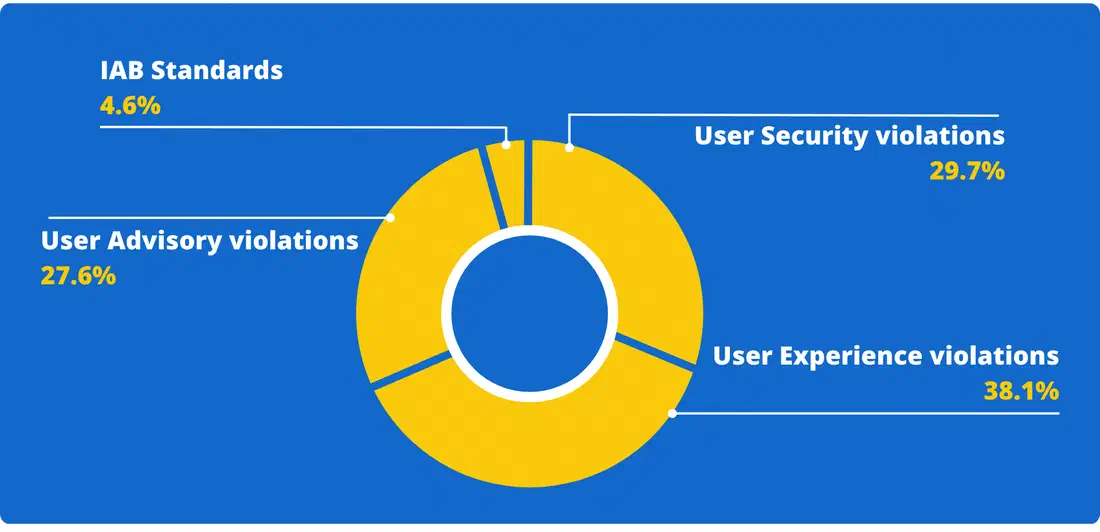
As we can see above, most Malvertising attacks in 2024 fell into the User Experience Category. This category is an important one to take into account, since like its name indicates, it impairs the end user’s experience on a Publisher website by showing dodgy ads that are poorly formatted, act in unexpected ways or even endanger their devices. When this happens, the end user will most likely click off and never return, affecting the Publisher’s revenues and traffic numbers. This makes it very important for website Publishers and Ad Networks to invest in brand safety and user experience protection software.
3 of the top 6 violation increases were User Security Violations
Continuing on you can find the top 6 violation increases of 2024, compared to the year prior, 2023. Half of the violations shown below are specifically designed to endanger end user safety, infecting their devices with Phishing, Malware and Scareware techniques. Plus, steep increases in ad size and weight violations have been reported, which isn’t great news for website user experience:
**Heavy-ad (User Advisory) +1084.70%: **Heavy Ads violate Google’s heavy ad intervention policy and consume more than 4MB of network bandwidth. Unoptimized and heavy CPU usage affects processing speed and ends up blocked by Chrome. To ensure that your site is free of ads that slow down the user experience and impact performance, AdSecure’s user experience protection software notifies end users of heavy ads and enable you to solve ad size issues to increase loading times.
Iab-ad-dimensions (IAB) +801.30%: Another way to** **solve ad size issues to increase loading times is with IAB-ad-dimensions, which flag ads that are not compliant with the dimensions recommended with the IAB Standards, which range between 100x200 - 150x300.
Insight: As we can see, there has been a massive increase in Heavy-ad violations (+1084.70%!), followed by IAB-ad-dimensions (+801.3%). This means that there is still a huge labour of educating Advertisers on how to properly format their ads to protect their investment, website reputation. At AdSecure we provide dedicated software to aid Ad Networks and Publishers in helping to promote a pleasant and seamless online experience for all.
Phishing-url-webrisk (User Security) +410.50%: The content of a Phishing site mimics the looks and feel of a trusted entity. For example, a bank or government entity. It then uses end user trust to scam them into revealing sensitive information such as passwords, phone numbers and credit card details. This detection is based on Phishing URL violations from Google WebRisk.
Malicious-url (User Security) +376.70%: These URLs host dangerous content such as phishing and drive-by exploits, designed to trick the end user into giving away their sensitive information, downloading malware, etc. This violation could end up in substantial monetary loss and device destruction.
Scareware (User Security) +66.90%: An alert is shown claiming that the end user’s device has been infected with a virus. The bad ad poses as trustworthy detection software and prompts end users to pay for their help, accessing credit card information, and even making them download pretend detection software which turns out to be Malware or viruses! This is bad news for end users, the website where the ad was found, and the Ad Network’s reputation!
Unsafe-content-adult (User Advisory) 11.90%: End users are exposed to unrequested explicit sexual or pornographic images and content. This can be very damaging to younger audiences, as well as the reputation of the website where the ad was found.
Malvertising Insight: In 2024, Malvertisers started launching AI-generated Ad Security attacks (opens in a new tab), for instance, building droppers for email Phishing attacks, or using GenAI to create complicated malicious code. Plus, Google Ads vulnerabilities have been continuously exploited to target online audiences’ devices. In some cases, Malvertisers have managed to hijack legitimate Advertiser Google accounts (opens in a new tab) to bypass the Ad Network’s security, launching their attacks at the expense of these Advertisers’ reputation.
How Malvertisers endangered user security in 2024: **4.6% of all violations were IAB violations **
The IAB Standards are a set of guidelines set by the Interactive Advertising Bureau in order to to help Advertisers, website Publishers and Ad Networks guarantee ad quality and compliance, as well as a better end user experience. It is crucial for stakeholders in the ad tech industry and online businesses to comply with these guidelines, as failure to do so negatively affects user experience and may result in websites being flagged or penalized by Google. This is yet another way how Malvertisers endangered user security in 2024. At AdSecure we ensure that these standards and technical requirements are met. Here’s how IAB detection evolved in 2024:
Iab-ad-dimensions 79.80%: The IAB recommends certain ad dimensions that contribute to the majority of revenue and are sufficient to advertise across multiple screen sizes. This detection will flag ads that are not compliant with the IAB standards in terms of ad dimension, giving you the chance to solve ad size issues to increase loading times.
**Iab-ad-compression 15.90%: **What are standard IAB sizes? To optimize the file size for delivery of an ad to a browser, the assets within the ad should be delivered in compressed formats such as gzip. This detection will flag ads that are not compliant with the IAB standards within this category, which means they are not delivered in a compressed format.
IAB-ad-weight 3.70%: As explained above, this detection flags ads that are not compliant with the IAB standards in terms of ad weight and according to what are standard IAB sizes.
Iab-ad-request-count 0.60%: Ads consist of multiple resources. The number of requests made to fetch these resources has a significant impact on the load performance of the ad as well as on the page where the ad is displayed. This detection will flag ads that are not compliant with the IAB standards in terms of ad request count. IAB recommends a maximum of 10 requests.
Conclusion: Protect user experience and safety online with AdSecure’s user experience protection software
Looking to protect user experience and online safety on your platform or website? If you are a website Publisher or Ad Network, you know the drill: Enforcing ad compliance and safety is crucial to ensuring a great end user experience online. 2024 has brought us steep User Security and Experience increases, especially when it comes to ad sizes, weight, and corrupted links. At AdSecure we offer 360 degree monitoring and protection for your ad supply chain by automating your ad verification process before ad campaigns go live & while they are running. Get in touch with our team or why not start a free 14 day trial now (opens in a new tab) to start managing how to stop IAB Standards Ad Sizes violations?