We have recently posted our Q3 2024 Violations Report, where we analyzed Malvertising trends for the quarter and compared them to the quarter before, worldwide. Our aim is to bring you useful insights to help you detect and anticipate potential Malvertising attacks on your Ad Network or website, keeping your ad supply chain clean at all times. To continue training you on what signs to be looking out for, on this occasion we focus on the top online Malvertising security risks registered in the UK, US and Tier 1 EU in Q3 2024. In this article you will find out how to detect and block online threats with security software, what the most popular ad violations have been for the 3 GEOs, and which ones have experienced the most steep increases, or decreases.
T**op 5 **online Malvertising security risks registered in the UK, US and EU
Here are the 5 top online Malvertising security risks registered in the UK, US and EU: Malvertising activity in the US accounted for 14.2% of all violations detected during the third quarter of 2024. Tier 1 countries in the EU accounted for 26.2% and the UK alone accounted for 3.2%. Continuing on we will show you the top 5 ad violations and violation categories per GEO:
26.2% of Malvertiser activity was registered in the EU: How to block unwanted mature content in malicious ads
As numbers show, ad creative and URL quality was heavily impaired in Tier 1 EU countries this past quarter, with 3 violations which affected ad URLs, dimensions and loading times. So, it is extremely important to learn how to protect end users from corrupted ad links in the EU:
Ssl-non-compliant (User Security) 28.10%
Unsafe-content-adult (User Advisory) 26.90%
Malicious-url-virustotal (User Security) 16.50%
Iab-ad-dimensions (IAB Standards) 15.60%
Landing-page-error (User Experience) 12.90%
**Malvertising insights - Protect end users from corrupted ad links in the EU: **End users are increasingly wary of URLs and sites that don’t use secure connections, have broken links, or badly formatted ads that take ages to load. These sites may experience slower loading times and compatibility issues with modern browsers, hugely impairing end user experience and on occasion displaying their sensitive information to third parties. Search engines like Google prioritize websites with strong security measures, so your website’s search engine ranking might be impacted, reducing visibility and organic traffic, erode visitor trust and impact business health, or even lead to penalties and fines! Wondering how to block unwanted mature content in malicious ads and other threats? AdSecure can help you analyse your ad campaigns pre and post launch to avoid links being corrupted or tampered with at any stage of the campaign.
The US accounted for 14.2% of bad user experience ads worldwide
Here’s how end user experience was impaired by bad ads and security threats in the US in Q3 2024:
Back-button-hijack (User Experience) 26.20%
Malicious-url-virustotal (User Security) 24.40%
Javascript-dialog-on-entry (User Experience) 24.00%
Ssl-non-compliant (User Security) 13.10%
Threat-intelligence (User Advisory) 12.30%
Malvertising insights - **How to prevent online fraud and phishing in the US: **Have you ever wondered how back button hijack attacks affect US users? A back button hijack attack is a malicious technique where a threat actor manipulates the behavior of the browser’s back button to redirect users to a different website, or to simply keep them on the website they are currently on to continue promoting their products. Whilst this is classed as a User Experience violation, this violation could end up being more than plain annoying. It could lead to credential theft, Malware infections, Cross-Site Scripting (XSS) Attacks, Phishing attacks, financial fraud, or worse. Get in touch with the AdSecure team to find out how to prevent online fraud and phishing risks in the US!
3.2% of all online Malvertising security risks were registered in the UK
Here are the top 5 online Malvertising security risks registered in the UK, which affected end user safety and welbeing online:
Ssl-non-compliant (User Security) 26.80%
Unsafe-content-adult (User Advisory) 25.70%
Malicious-url-virustotal (User Security) 23.50%
Iab-ad-compression (IAB Standards) 12.10%
Threat-intelligence (User Advisory) 11.90%
Malvertising insights - How to block unwanted mature content in malicious ads: Unfortunately, unsafe-content-adult has been one of the main Malvertising trends in the UK. When it comes to Unsafe-content-adult, it is important to acknowledge the impact that it can have on website end users. Unexpected exposure to explicit or harmful content can cause distress, anxiety, and emotional trauma, especially for children and vulnerable individuals. Definitely not something that you want to have your brand associated with. Plus, if the content is explicit or exploitative, it could lead to criminal charges. If you are wondering how to block unwanted mature content in malicious ads, test out AdSecure’s real-time blocking tool to protect your ad campaigns or website against online malvertising security risks registered in the UK!
Top 10 online Malvertising security risks registered in the UK, US and EU in Q3 2024
On the graph below you can see the top 10 online Malvertising security risk increases registered in the UK, US and EU, as well as their decreases:
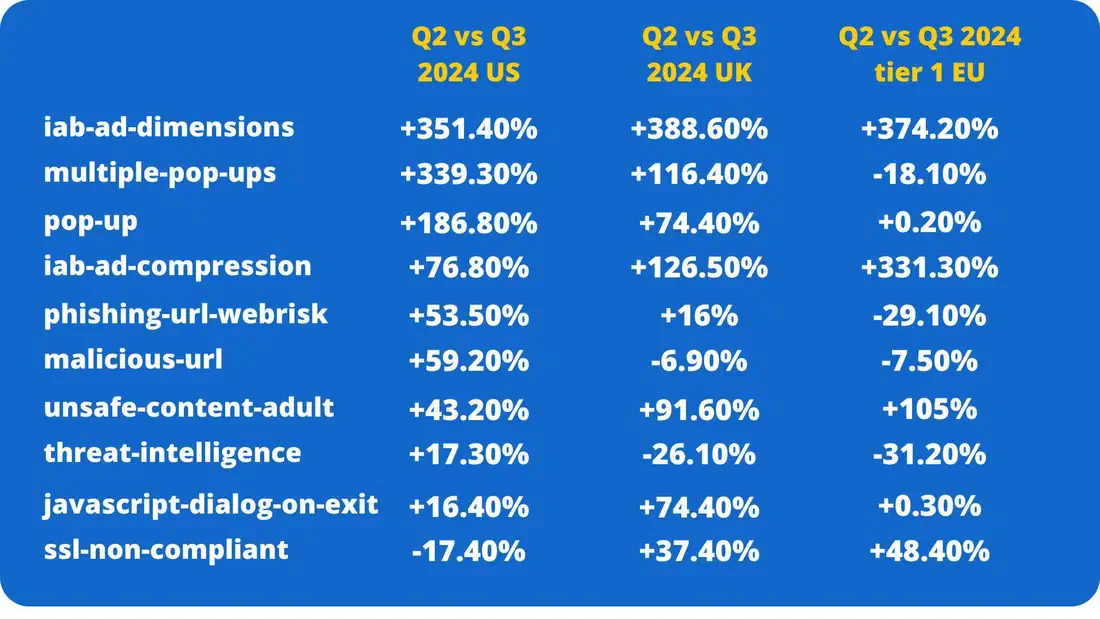
As we can see, the GEO with the most Malvertising activity increases registered during the quarter is the US, with 9 of the 10 top violations ramping up in numbers. On the other hand, the GEO which displays the most decreases in cybercriminal activity is Tier 1 EU, with 3 violation decreases and more moderate numbers across the board. Right in the middle we can find the UK, with 8 violations experiencing noticeable increases, and 2 decreases.
Top 10 online Malvertising security risks of Q3 2024 explained
**#1 IAB-ad-dimensions (IAB Standards): **This is one of the top 10 ad violation increases in the US in Q3 2024, with +351.40% increase in the US, +388.60% in the UK and +374.20% in the EU, making it extremely important to fins ways to protect end users from corrupted ad links in the EU. IAB-ad-dimensions flag ads that are not compliant with the dimensions recommended with the IAB Standards, which range between 100x200 - 150x300.
**#2 Multiple-pop-ups (User Experience): **This violation displayed high numbers in two GEOs, with +351.40% in the US, and +388.60% in the UK. Another powerful Malvertising trend in the UK in Q3 2024. This is similar to Pop-up violations, but as the name indicates, the Malvertiser floods the end user’s screen with an overwhelming amount of pop-ups, which are potentially infected with non-compliant or dangerous content.
#3 Pop-up (User Experience): Pop-ups and Tabunders are automatically triggered without interaction. Malicious Advertisers often exploit pop ads to automatically download harmful software into the end user’s device, endangering their personal data and providing a less than desirable experience on a Publisher website. This detection has experienced increases across GEOs, although has been less present in the EU: +186.80% in the US, +74.40% in the UK, +0.20% in the EU.
#4 Iab-ad-compression (IAB Standards): According to the IAB Standards, to reduce file size and improve ad delivery speed, ad assets should be compressed using formats like gzip. This detection identifies ads that don’t adhere to this rule. This violation has experienced a +76.80% increase in the US, +126.50% in the UK and +331.30% in the EU.
#5 Malicious-url (User Security): End users unknowingly click malicious links only to be directed to malicious websites riddled with malicious software, viruses, and other non-compliant or unsolicited content. This detection only experienced increases in the US (+59.20%)
#6 Phishing-url (User Security): 2 GEOs have displayed increases on Phishing violations: US, +53.50%, and UK, +16%. Phishing websites masquerade as trusted organizations to deceive end users into disclosing personal data, such as passwords, credit card numbers, or social security numbers. Once obtained, this information can be exploited by cybercriminals for malicious purposes.
#7 Unsafe-content-adult (User Advisory): End users are exposed to unrequested sexual or pornographic images and content that could be very damaging to younger audiences. This quarter it has visibly endangered the reputation of websites across the 3 GEOs: US (+43.20% increase), UK (+91.60% increase) and EU (+105% increase). This violation was one of the top online Malvertising security risks registered in the UK.
#8 Threat-intelligence (User Advisory): This violation has only displayed increases in the US (+17.30%). By analyzing the behavior of specific URLs, the Threat Intelligence tool assigns a risk score from 5 to 0, indicating the likelihood and severity of potential ad violations. This enables proactive identification and mitigation of risks before they impact live systems.
#9 javascript-dialog-on-exit (User Experience): A Javascript alert that pops up when the end user wants to close the active tab or leave a specific website. This has got the potential to not only annoy the end user, but also to scare them away from the website. Q3 2024 Increases go as follows: US, +16.40%, UK, +74.40% and EU, +0.30%.
#10 ssl-non-compliant (User Security): This violation has experienced increases in the UK (+37.40%) and the EU (+48.40%). These are ads that contain at least one unsecured item in the chain of resources (unsafe, no https, mixed content, ssl version or cipher mismatch). This could expose end users information to undesirable third parties.
**Conclusion: **How to detect and block online threats with security software
Now you know what the top online Malvertising security risks registered in the UK, Us and EU were this past quarter. So, you understand the importance of ensuring that your ad supply chain is free of bad quality or dangerous ads - Join AdSecure: Our advanced tool monitors campaigns before and after launch, proactively identifying and blocking threats. We can help you protect end users from corrupted ad links in the EU, EU, UK, and all over the world! By rejecting or suspending malicious ads, you maintain a positive and safe online experience for your end users, and to protect your brand reputation. Wondering how to block unwanted mature content in malicious ads, or how to prevent online fraud and phishing risks in the US? Contact us now to explore how AdSecure can help you prevent these and more threats, or why not try it for free right now! (opens in a new tab)